

Establishing a pharmaceutical plant in a Free Trade Zone in Colombia can be a strategic decision for those seeking to optimize costs and expand their export capacity. The tax and customs benefits offered by the free trade zone regime, such as exemption from VAT and import duties or a flat 20% income tax rate (applicable with an internationalization plan), represent real financial advantages. However, operating a pharmaceutical production plant within these zones requires strict compliance with both local and international technical and sanitary regulations.
From INVIMA requirements to Good Manufacturing Practices (GMP), FDA, and EMA certifications, every detail counts to ensure operational viability, product quality, and access to global markets. This blog breaks down what you need to know to balance the economic incentives of Free Trade Zones with the regulatory standards governing the pharmaceutical industry.
Legal framework for free trade zones in Colombia: what you need to know
Any pharmaceutical production plant wishing to establish itself in a Free Trade Zone must understand the legal framework governing its operations. In Colombia, Free Trade Zones are primarily governed by Law 1004 of 2005 , Decree 2147 of 2016 , and the more recent Decree 278 of 2021 , regulations designed to enhance competitiveness and streamline procedures for industrial and service companies with export potential.
These territories are considered "outside" the national customs regime, which allows them to access a series of tax, exchange, and foreign trade benefits. However, operating in a Free Trade Zone does not exempt companies from complying with the technical and health requirements specific to the pharmaceutical sector.
In the specific case of pharmaceutical plants, the most suitable option is the Permanent Free Trade Zone : a multi-user space where multiple industrial or service companies can establish themselves. In the Western Free Trade Zone , this model provides access to tax and customs benefits, ready-to-operate infrastructure, and an ecosystem designed to facilitate the establishment, regulatory compliance, and export growth of the pharmaceutical sector.
INVIMA regulations that apply to a pharmaceutical plant in a Free Trade Zone
Operating a pharmaceutical production plant within a Free Trade Zone does not imply any exemptions regarding health or technical regulations. INVIMA (the National Institute for Food and Drug Surveillance) applies the exact same regulations to all plants, regardless of their geographic location. This includes regulations concerning design, operation, quality, and safety.
Among the main requirements are:
- Health Register: Required for the manufacture, import, export, or sale of medicines in Colombia. It requires submitting a technical file with information on the product, components, manufacturing processes, and stability and safety testing.
- Certification in Good Manufacturing Practices (GMP): a prerequisite for obtaining health registration. Requires an on-site inspection by INVIMA.
- QA: A robust system with sampling protocols, physical-chemical and microbiological analysis, supported by validated documentation, must be implemented.
- Key regulations:
- Decree 677 of 1995 (registration and health surveillance)
- Resolution 1160 of 2016 (GMP manual)
- Decree 334 of 2022 (renewal and modification of records)
- Resolution 3619 of 2013 (Good Laboratory Practices)
Good Manufacturing Practices (GMP) in Colombia and their mandatory compliance
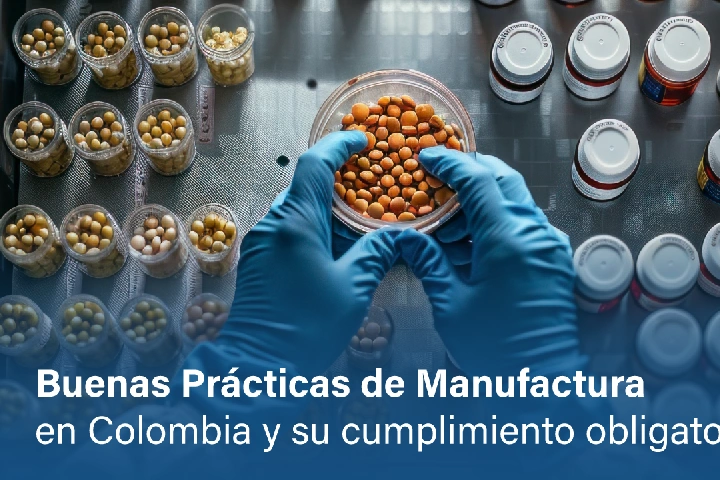
Good Manufacturing Practices (GMP) are the most critical technical standard for any pharmaceutical manufacturing plant . Their objective is to ensure that products are manufactured consistently, under controlled conditions, and to the quality required by regulatory authorities.
In Colombia, GMP compliance is mandatory , including for facilities located in Free Trade Zones. INVIMA is the authority responsible for granting GMP certification, which must be renewed periodically through on-site inspections.
The GMP principles cover:
- Quality management: All processes must be documented, validated and maintained within acceptable parameters.
- Facilities and equipment: should be designed to prevent cross-contamination and allow for proper cleaning and maintenance.
- Technical documentation: batch records, deviations, CAPAs and standard operating procedures.
- Staff: qualified, trained and continuously evaluated.
- QA: robust testing of inputs, work-in-process and finished product.
INVIMA aligns with WHO guidelines (according to Resolution 1160 of 2016), which facilitates international recognition. Equivalence with regulations from agencies such as the FDA (USA) or the EMA (European Union) is also recognized in certain cases.
International certifications required for exporting from a pharmaceutical plant
If the goal of a pharmaceutical production plant in a Free Trade Zone is to conquer international markets, international certifications become a strategic requirement. Although INVIMA's GMP certification is the mandatory starting point in Colombia, exporting to countries with demanding regulatory frameworks requires compliance with additional standards.
Main international certifications:
- FDA (United States): CGMP (Current Good Manufacturing Practices) certification is essential for marketing medicines in the U.S. The FDA conducts rigorous and periodic inspections.
- EMA (European Union): EudraLex Volume 4 establishes the requirements for obtaining marketing authorization. It requires compliance with European GMP standards and comprehensive clinical documentation.
- ANVISA (Brazil): Relevant to the Latin American market, it requires specific auditing and certification for the entry of products into the Brazilian market.
- ISO (International Organization for Standardization):
- ISO 9001: Quality management.
- ISO 13485: Medical devices.
- ISO 15378: Primary packaging for pharmaceutical use.
- ISO 22716: GMP for cosmetics.
Infrastructure required for a pharmaceutical production plant in a Free Trade Zone

Infrastructure is a crucial pillar for meeting the regulatory requirements of a pharmaceutical production plant , especially when operating in a Free Trade Zone. The facilities must be designed to control critical variables such as temperature, humidity, cross-contamination, and process traceability.
Key requirements demanded by INVIMA:
- plant design: must allow a logical flow of the production process, minimizing the risk of errors and contamination.
- Clean areas: controlled environments with HEPA filtration, positive pressure and constant monitoring.
- Materials and finishes: Smooth, washable, chemical-resistant surfaces with no right angles to prevent residue buildup.
- HVAC Systems: essential for environmental control in clean rooms, according to ISO classification (Class 5 to 8 depending on the activity).
- Segregated areas: for hazardous substances, antibiotics, hormones or biological products.
Installation and operation requirements to access the free trade regime
Setting up a pharmaceutical production plant in a Free Trade Zone in Colombia not only involves construction and infrastructure, but also requires compliance with a series of legal procedures and requirements that allow the company to operate under this special regime.
Key steps and conditions:
- Legal Constitution: The company must be legally domiciled in Colombia and registered as an industrial user with the DIAN and the Ministry of Commerce, Industry and Tourism (MinCIT).
- Registration as an industrial user: In the case of pharmaceutical companies, the category of industrial user of goods.
- Internationalization plan: required by the Ministry of Trade and Industry (MINCIT) to access the preferential 20% income tax rate. This plan details export goals and investment timelines.
- Work commitments: meet minimum goals for direct employment generation, established according to the amount invested and type of Free Trade Zone.
- Document management: Maintain detailed records of production, traceability, quality control, inventories, and compliance with Good Manufacturing Practices (GMP).
- Health authorizations: obtain the INVIMA health registration, and if the drugs contain controlled substances, process permits from the National Narcotics Fund.
- Environmental and waste management system: in accordance with local regulations, especially relevant for production with chemicals or biologicals.
In addition, the company must coordinate with the Free Trade Zone administration to comply with protocols for the entry of personnel and merchandise, 24/7 surveillance, and internal operating regulations.
Pharmaceutical plant in a Free Trade Zone? These are the keys to sustainable success
For a pharmaceutical production plant in a Free Trade Zone to not only comply with regulations, but also be profitable and competitive in the long term, it is essential to adopt a strategy that integrates regulatory compliance, operational efficiency and an international vision.
Keys to a successful model:

- Compliance by designIntegrating INVIMA and GMP requirements from the architectural planning phase avoids costly rework and streamlines certifications.
- Robust quality management system: It's not enough to have manuals; it's essential to implement an organizational culture based on quality, traceability, and continuous improvement.
- Continuous staff trainingINVIMA requires qualified personnel. Investment in specialized technical training in sterile production, GMP documentation, and audit management is essential.
- Infrastructure aligned with international standards: HVAC systems, real-time environmental monitoring, equipment validation, waste control, and computerized processes are part of the global standard.
- International Certification Plan: Creating a roadmap to obtain FDA, EMA, or ISO certification allows you to enter new markets and position yourself as a reliable partner in global supply chains.
- Export strategy: Take advantage of free trade agreements and health agreements to optimize logistics costs, delivery times, and preferential access to international markets.
- Permanent communication with INVIMA: Establishing channels of dialogue from the installation stage guarantees support, clarity, and risk reduction in the regulatory process.
Ready to set up your pharmaceutical plant in a Free Trade Zone?
Operating a pharmaceutical plant from the Western Free Trade Zone in Colombia is not only a smart financial decision, but also a strategic investment in international competitiveness. The tax and customs benefits of the free trade zone regime can translate into a real operational advantage, but only if accompanied by strict compliance with national and international health regulations.
At Zona Franca de Occidente , we combine world-class infrastructure, expert consulting, and a strategic location in the heart of the country's industrial zone. Whether you're looking to establish a new plant or relocate existing operations, we're the ideal partner to help you meet INVIMA, FDA, or EMA standards and maximize your business's export potential.
Contact us and discover how your pharmaceutical plant can grow with us.