

Today more than ever, Free Trade Zones have demonstrated their ability to boost the economy of businesses, regions, cities, and the country as a whole. The numbers prove it, and at Zona Franca de Occidente, we'll explore this positive context and explain how to establish your company in a Free Trade Zone in Colombia and the requirements to get started. Be part of the driving force of the country's economy!
And what are these encouraging numbers? First, it should be noted that “ the National Directorate of Taxes and Customs, DIAN, reiterated, through a ruling, that operations carried out from the national customs territory to free trade zones constitute exports,” reports the newspaper El Tiempo.
The same media outlet asserts that “ this approach allows for the development of highly productive and competitive industrial processes, based on the principles of safety, transparency, technology, clean production, and sound business practices. It also simplifies procedures for trading goods and services, facilitating their sale.”
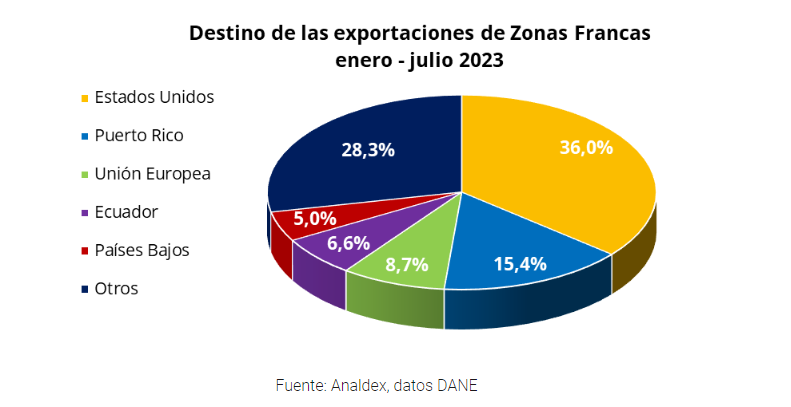
In line with this, it was reported that in June 2024, merchandise exports from Colombian Free Trade Zones registered a 12,8% increase, rising from US$238,1 million FOB in June 2023 to US$268,5 million FOB in the same month of 2024, according to DANE (National Administrative Department of Statistics). Similarly, the top five destinations for the country's exports, according to DANE data , were as follows:
Given this scenario, it's impossible not to consider the advantages of having a business in these special areas, so it's vital to understand how to establish your company in a Free Trade Zone in Colombia and the requirements to get started.
Key steps to establish your company in a Free Trade Zone in Colombia
For those bold entrepreneurs who want to go further, and for those who still have doubts, we'll delve into the intricate details of how to establish your company in a Free Trade Zone in Colombia. Setting up in a special area like this requires a step-by-step guide.
The discovery
Before delving into the practical details, it's essential to understand what Free Trade Zones actually are and why they're so attractive for business in Colombia. These are delimited areas that offer tax, customs, and logistics benefits to companies operating within them. These areas aim to boost foreign trade, investment, and job creation.
Research and selection: beyond the surface
Choosing the right Free Trade Zone is like choosing the land on which to build your house. You must consider several aspects, including the geographic location and the additional services it offers, such as transportation infrastructure, security, and logistical connections. It's also good to hear the opinions of other organizations located there in terms of operational efficiency and satisfaction.
At Zona Franca de Occidente , we manage customized projects with the development of Built-to-Suit (BTS) warehouses, adapting each one to your production processes, which translates into efficient investments and optimized resources. We also offer an internal road network with widths ranging from 10 to 17 meters for heavy traffic, a large external parking area for cargo vehicles, warehouses with loading docks over 18 meters long, and internal and external parking for visitors, among many other features.
Registration and documentation, ensuring the legal framework of the company

With the Free Trade Zone chosen, it's time to tackle the bureaucracy. A crucial step in establishing your business in a Free Trade Zone in Colombia is registering your company there. This includes legal incorporation, obtaining specific operating permits, and fulfilling other legal requirements.
You submit a qualification request to the Free Trade Zone operating company, known as the User Operator, and the explanatory documents are submitted.
Some of the documents to be submitted are:
- Certificate of existence and legal representation: Issued by the Chamber of Commerce, it certifies that the company is legally established and lists the persons authorized to represent it.
- Copy of the articles of incorporation: Establishes the legal structure, detailing information about the shareholders, the company structure, and other legal aspects.
Free Trade Zone Documents:
- Lease or concession agreement: This agreement certifies authorization to use the space in the Free Trade Zone. This agreement must be signed with the corresponding Free Trade Zone administration.
- Location Certificate: Provided by the Free Trade Zone, this certificate confirms the exact location of your company within the Free Trade Zone.
Tax Documents:
- Unique Tax Registry (RUT): This is a fundamental tax document. You must obtain your company's RUT, indicating its economic activity and tax information. It is vital for establishing your company in a Free Trade Zone in Colombia and the requirements for starting a business.
- Tax Background Certificate: Issued by the National Tax and Customs Directorate (DIAN), this certificate verifies that the company has no outstanding tax debts.
- Certificates of Compliance with Technical and Environmental Standards: Depending on the nature of your business, you may need certificates demonstrating compliance with specific technical and environmental standards.
- Extracontractual Civil Liability Policy: Some Free Zones may require an insurance policy that covers civil liability.
Customs and logistics procedures
Another requirement to get started after registering your organization is to navigate efficiently in the customs and logistics environment. You must understand the customs procedures required to import and export goods, as well as strategies to optimize inventory management and the supply chain.
Developing an ideal team
Among the requirements for starting a business, it's always important to consider the human capital being organized; that's fundamental. To achieve this, it's important to understand the specific labor regulations and tactics for fostering a positive work environment, staff training, and talent retention.
Environmental commitment and sustainability

In the era of environmental responsibility, your company must excel in terms of sustainability. It's also important to understand environmental regulations in a Free Trade Zone and implement sustainable practices, which will enhance your reputation as an entity committed to environmental stewardship.
Establishing your business in a Free Trade Zone in Colombia is a process that requires guidance and support, but the results are rewarding. With this detailed guide, you'll be equipped with the knowledge needed to make informed decisions and forge your path to business success in this unique environment.
At Zona Franca de Occidente, we advise and support you so you can establish yourself and enjoy numerous benefits. Talk to us to learn about the personalized process.
FAQ
1. What is a Free Trade Zone in Colombia?
A free trade zone is a delimited geographical area where tax, customs, and foreign trade benefits apply to encourage investment and exports. Companies established in these zones enjoy income tax reductions and exemption from tariffs, among other benefits.
2. What are the requirements for establishing a company in a Free Trade Zone?
To establish a company in a Free Trade Zone, you must meet requirements such as creating an investment project, demonstrating the company's financial capacity, and complying with the specific regulations of the Free Trade Zone in which you wish to operate. In addition, you must obtain certification as a free trade zone user from the National Tax and Customs Directorate (DIAN).
3. What tax benefits does a Free Trade Zone offer?
Companies in Free Trade Zones enjoy a reduced income tax rate of 20%, exemption from tariffs on imported raw materials and capital goods, and are not subject to value-added tax (VAT) on imported goods.
4. What is the process for registering a company in a Free Trade Zone?
The registration process includes submitting an investment project, review by the Free Trade Zone administration, obtaining user qualification, and formalizing a contract with the zone administration. Once approved, the company can begin operating within the Free Trade Zone.
5. What types of companies can be established in a Free Trade Zone?
Industrial goods companies, industrial service companies, and commercial companies can be established. These range from manufacturing to technological or logistics service companies, as long as they meet the requirements established by the Free Trade Zone.
6. What is the minimum investment required to establish a Free Trade Zone?
The minimum investment varies depending on the type of user, the available capital, and the number of investors.
7. Is it possible to export products from a Free Trade Zone?
Yes, one of the main benefits of establishing a Free Trade Zone is the ease of exporting products, as tariff barriers are eliminated and access to international markets is facilitated.
8. What competitive advantages does a Free Trade Zone offer my company?
Establishing a Free Trade Zone can improve your company's competitiveness by reducing tax and customs costs, streamlining logistics processes, and facilitating access to international markets with a regulated environment that promotes investment and exports.